
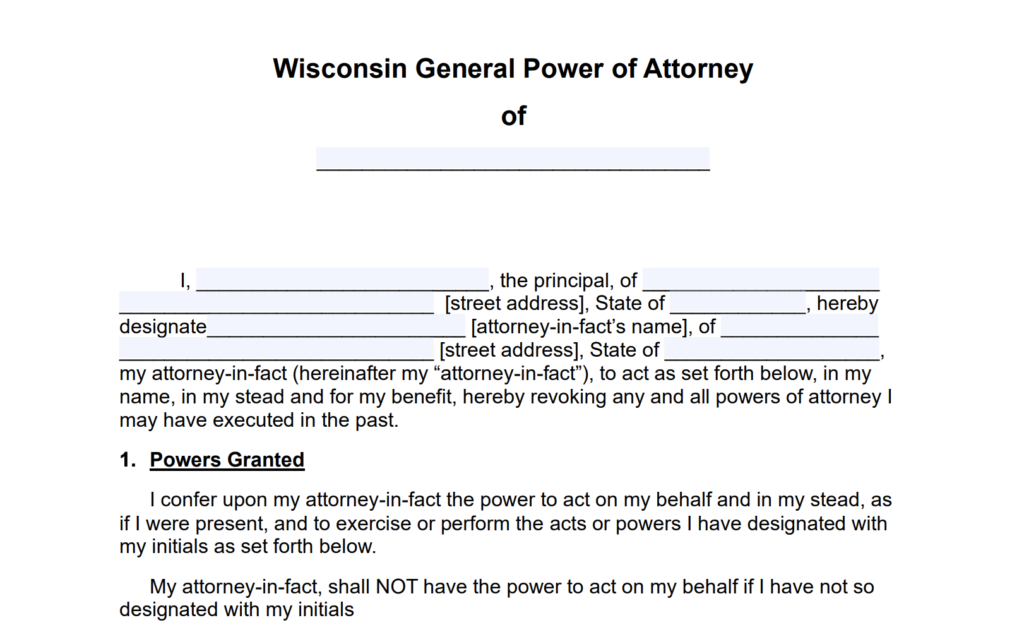
A Wisconsin General (Financial) Power of Attorney Form is a legal document that allows someone to appoint another person to manage financial matters on their behalf.

Understanding the Wisconsin Financial POA
The Wisconsin General (Financial) Power of Attorney Form gives an appointed “agent” the authority to manage financial affairs for another individual, known as the “principal.” These powers may include handling bank accounts, signing financial documents, managing investments, and conducting property transactions. :contentReference[oaicite:0]{index=0}
What Powers Can Be Granted?
- Bank account management
- Paying bills and debts
- Managing investments
- Handling tax matters
- Real estate transactions
- Business and financial operations
Main Parts of the Form
A Wisconsin financial power of attorney form usually contains the following sections:
- Principal Information: Person granting authority
- Agent Information: Authorized representative
- Specific Financial Powers: Powers assigned to the agent
- Special Instructions: Limitations or additional directions
- Effective Date: When authority begins
- Signature & Notary: Legal validation requirements
Sample Structure
Wisconsin General Financial Power of Attorney

Principal: [Full Name]
Agent: [Full Name]

Granted Powers:
- Banking
- Investments
- Real Estate
- Tax Matters

Special Instructions: [Optional]

Principal Signature: __________
Notary Public: __________
Wisconsin Signing Requirements
Under Wisconsin law, the principal’s signature must generally be notarized for the power of attorney to be legally valid.
State law also provides that powers of attorney are presumed durable unless the document specifically states otherwise.
Mid-Article Insight: Why Financial POA Documents Matter
Financial power of attorney forms are often associated with estate planning, but their importance goes far beyond long-term legal preparation. In real-life situations, people frequently need temporary financial assistance during travel, illness, military deployment, or emergencies.
A properly drafted Wisconsin financial POA allows someone trusted to manage critical responsibilities without court intervention. This can include paying bills, accessing accounts, or signing important documents when the principal cannot act personally.
Community discussions online also show that many individuals misunderstand the notarization and validity requirements of financial POAs in Wisconsin. Some users believe witnesses alone are enough, while legal professionals repeatedly point out that notarization is generally required under Wisconsin Statute § 244.05.
Another important point is choosing the right type of POA. A “general” financial POA may end if the principal becomes incapacitated unless structured differently, while a durable version is designed for long-term continuity.
For related legal forms, you can explore Virginia Financial Power of Attorney and California Advance Directive Form.
General vs Durable Power of Attorney
| Feature | General POA | Durable POA |
|---|---|---|
| Financial Authority | Yes | Yes |
| Ends Upon Incapacity | Often Yes | No |
| Typical Use | Short-term or temporary needs | Long-term planning |
Common Mistakes to Avoid
- Failing to notarize the form
- Granting overly broad authority
- Choosing an unreliable agent
- Not reviewing state-specific legal requirements
Helpful Legal Resources
For official Wisconsin legal references and forms, you can visit:
Current Situation
The current situation shows increased use of financial power of attorney forms as families focus more on emergency planning and financial management preparation.
Digital PDF templates are now widely used because they simplify the process while still meeting Wisconsin’s notarization requirements.
Conclusion
The Wisconsin General (Financial) Power of Attorney Form is an essential legal document that allows trusted individuals to manage financial responsibilities efficiently and legally.
By understanding Wisconsin’s legal rules and properly completing the form, you can ensure financial continuity and reduce complications during unexpected situations.